Under-Dash Green Box

As early as 1985 and as late as 1987, the fuel injection wiring harness contains a separate plug with two rows of holes.  These fit into a green box that mounts to the bottom of the under-dash area with a 10 mm bolt that points up.

A kind person pointed out to me that this is the idle control module. I have enough of them to offer them for sale at $30 each.

Coolant Overflow Bottle Location

Up to 1987, the 325 had the coolant overflow bottle located at the passenger side, and it had a simple shape, sort of like a hot dog sandwich.

For newer models, the coolant overflow bottle was located at the driver’s side, nearer to the front, and it had a more complex shape, sort of implying subtle internal ribs or corrugations.

Radiator Mounting

The radiator fits into two rubber-coated receptacles at the bottom, and then at the top, two bolts hold it in position, one on the driver’s side, one on the passenger side.

That’s it — nice and simple.

The Carbon Canister Ring Clamp

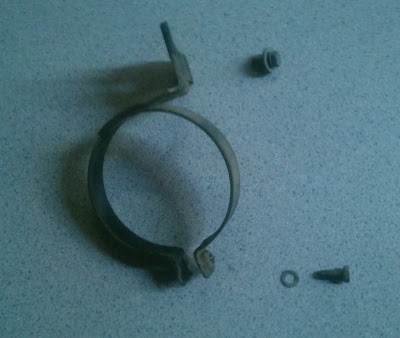
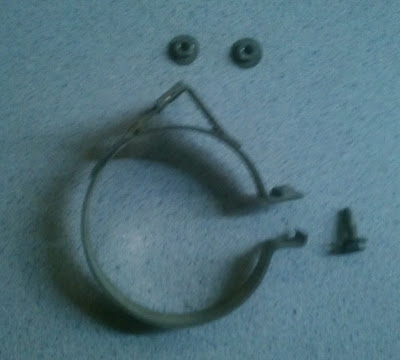
In the engine compartment is a carbon canister to help contain fumes.  A steel ring clamp, maybe 4 inches in diameter, holds the canister in place, attached to the driver’s side of the engine compartment, fairly low down, slightly below and to the rear of the power steering fluid bottle.

To loosen the clamp, undo the 10 mm bolt.

To remove the clamp from the car, undo two 10 mm nuts.

I sell used clamps for $5 each.

Fuel Injection Computer Cosmetic Cover

When someone opens the glove compartment, BMW didn’t want them to see the fuel injection wiring harness terminating at the fuel injection computer.

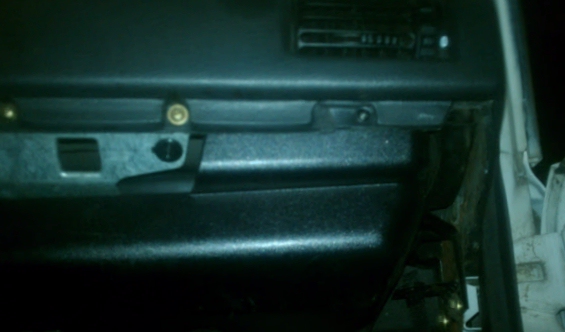
IMAG3931Instead, the person sees a pretty black plastic plate, that goes right below the fuel injection computer and forms a sort of ceiling for the glove compartment.

This plate also helps hold up the fuel injection wiring harness in case it felt like sagging.  It also has a little lamp that lights up when someone opens the glove compartment.

You do need to remove this plate so as to get to the fuel injection computer.

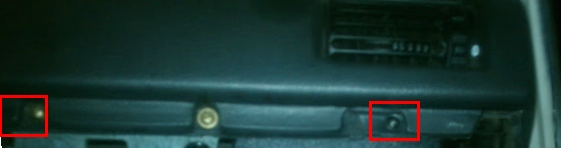
To remove the plate, use a Philips screwdriver to remove the two black screws that attach the rearmost lip of the plate to the dashboard, close to where the glove compartment latch goes into.

IMAG3931Reach to the outboard side and find a plastic anchor that is positioned vertically.  Twist it 90 degrees and pull it out.

Reach to the inboard side and find a plastic anchor that is positioned horizontally.  Twist it 90 degrees and pull it out.  This might be harder because the fuel injection wiring harness might be putting some downward pressure on it.

When re-installing the plate, make sure that you thread the glove compartment flashlight recharging plug wire way down, so that the wire has lots of movement.

Also, remember to attach the wires to the light that’s embedded in the plate.

You do not have to remove the glove compartment to get to this plate, and if I can avoid removing the glove compartment, I do.  It can be a massive pain to reinstall and realign.

To be able to remove the plate all the way, you do have to loosen one of the straps that carry some of the forward weight of the glove compartment — the inboard strap.

Two wires attach to the plate, specifically for the little glove compartment light.  Slide them loose.

I sell used plates for $10 each.

If you need to remove the light lens from the plate, remove the plate from the car first, and then pry the lens loose from the outside using a flat-tipped screwdriver.  I sell used lenses for $5 each, without the light bulb.  I sell used light bulbs for $3 each.

Glove Compartment Latch Base

The glove compartment has a latch.  When you close the glove compartment, the latch clicks into a steel plate.

If someone has yanked too hard on the glove compartment, they can damage this plate.  I offer replacement units for $10.

At the front of the dashboard, at the lip of the opening made when the glove compartment swings down, the plate screws into the dashboard with two Philips screws.  The plate also has an inboard 10 mm bolt, about 6″ forward of the two screws.  This bolt goes vertically up into the car, for extra positioning.

The plate also holds up the inboard portion of the base of the fuel injection computer, and it attaches to this using two more such 10 mm bolts that go vertically upwards.

Some plastic trim, about 3″ long, slides over the inboard edge of the plate to prevent its sharp edge from chafing and eventually cutting into nearby wiring.

Even the Comparatively Simple E30 is Dang Complicated

While my project partner was installing a vast amount of parts in a 1987 325 that we’re putting together after yanking the engine and transmission, I installed … a glove compartment, almost.

I messed with it for three hours, enough to get it to never open again. The latch was stuck.  Finally, my best idea was to destroy the entire glove compartment with a ball joint separator. This is a 12″+ piece of metal with a very sharp edge — think evil screwdriver on steroids.  So, now I am smarter.  I know what not to do, sort of. I’m also glad that I have a stash of used glove compartments.

When working on these cars, some tasks entail fairly straightforward wrench-turning, and part of it is very subtle.   Getting the glove compartment aligned just so without its back inside corner hitting the fuel injection wiring harness … not straightforward.

While trying to get the glove compartment to open, I also destroyed the plate into which the glove compartment latches.  As a bonus, I also managed to break the little sensor that turns on the internal light, and I also broke the lock and latch itself.  That’s about it for the damage assessment for today, unless my wild smashing also broke the fuel injection computer.  No, wait … there’s more.  A few stabs went high and so the fresh air vent now is more … able to let in fresh air.

I now understand better than ever why owners can reach the point where they are overwhelmed and simply wanna unload the car for $50 if the junkyard is willing to haul it away.

I used to wonder why my 1992 735i was priced at $60K when new and at $3K when fifteen years old.  Something complex going seriously wrong, and creating either a massive amount of work or a massive repair bill … I can understand how more and more of this makes it non-viable to keep pouring money and time into the car.

Four factors make repair tasks more or less difficult for me:

  • Information. If I were clear as to the right steps and the pitfalls, I’d get much more done, with less damage, in the same amount of time.
  • Fasteners. A fresh stash would save a time and hassle when I lose or break them.
  • Additional parts in case bad surprises happen, like today.
  • An example car to go look at, to see what the correctly assembled picture looks like … that is very helpful to me.
  • The right tools, always — clean and ready.

I plan to keep methodically working the issues until I have this type of car figured out, and documented besides.

Interesting Work on an E30 BMW 325

Whether it’s the E30 325, 325e, 325i, 325ix, 325es or 325is, they all use all the same wonderful M20 engine … with the caveat that if its timing belt breaks, the valves can impact the pistons and severely damage the engine.

Perform enough preventative maintenance on the timing belt, and the risk of such a problem is low.

Back325For the last 12+ years, I have owned a delightful E30 1987 BMW 325.  It recently got a big tune-up and some drive shaft work done, and I lent it to a friend who drove it for a few months.  She handed it back to me, and I drove it from Tucson, AZ to … well, about 80 miles south of my shop in Fallon, NV when the clutch gave out in the middle of the night on highway 95.  The clutch was by then slipping merrily, warning me of its impending failure, but I’d hoped I could limp it all the way to my shop before the clutch gave out but … no such luck.  A clutch replacement was due.

I ruminated on it for a year or so.  I hate working underneath a car.  It basically consists of transferring the grime and dust from the underside of the car into my eyes and onto my face. Then, a few fasteners fall into my eyes, and a few parts fall onto my face.  If I lift the car high enough to not feel cramped, then the stakes go up too because whatever falls off next has a lot of energy, and my feet become the next target.

I used to work in an auto manufacturing facility. I observed how the engine, transmission, steering, front suspension and front hubs are all mounted on the front sub-frame. When the build the car, they lift all that up, as a unit, to mate with the car.

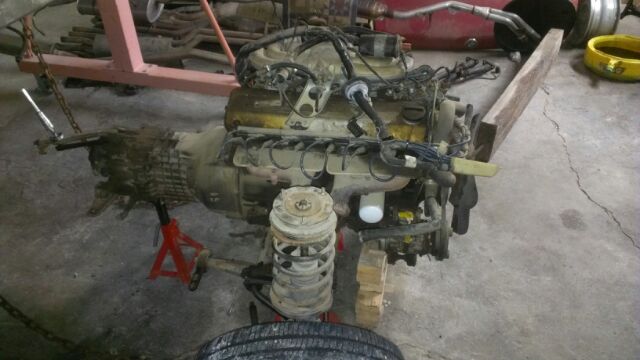
So, for this car, my shop took this approach.  We performed the process in reverse first.  A local muffler shop removed the exhaust and drive shaft, and then my shop detached the various fasteners, hoses, wires etc. that connected the front sub-frame assembly to the rest of the car.  Next, we put a gantry over the car and lifted the car body up, away from the sub-frame.

gantry01

That allowed us very convenient access to the engine and transmission.  Normally, to split the transmission from the engine requires some special vocabulary, but in this case, it wasn’t needed.

Normally, to replace the timing belt with the engine inside the car makes for a cramped work environment, with either of the two radiators, coolant or a/c, being just a few inches to the front of the action. With our new arrangement, there were wide open spaces to work in.

engine01

The things that we ended up replacing were intended to make the car very reliable as to typical points of failure:

  • Timing belt
  • Timing belt tensioner
  • Water pump
  • Both large coolant hoses
  • Belt that drives the alternator and water pump
  • Belt that drives the power steering
  • Belt that drives the a/c compressor
  • Clutch disk
  • Clutch pressure plate
  • Clutch throw-out bearing
  • Clutch pilot bearing

Additional items I might be tempted to swap out in future such situations are:

  • Alternator brushes
  • Shifter hardware
  • Front shock absorbers
  • Spark plugs

Enjoyable project! And I might soon be driving an E30 that I can cheerfully shift at the red-line without having to baby the engine or clutch.

This project also reminded me of how many things, large and small, can and do break during a project such as this, so if you are experiencing the same thing, and you need used parts, please contact us.

BMW E30 3-Series Glove Compartment Removal and Re-Installation

If you like, you can skip directly to where you can buy this part.

These instructions, for removal and re-installation of a BMW E30 glove compartment, are from my personal experience, doing this on several cars, including my personal-transportation 1987 BMW 325.

The little receptacle into which the flashlight fits has, no surprise, two-wires attached to it, but I couldn’t see any sort of plug by which they can be detached, so the next best idea is probably to use a thin flat-headed screwdriver to slip the catches that anchor the plug to the side of the glove compartment. I then moved the plug downwards, in the direction of the wiring.  The plug has, on one side, a raised profile that mates with a groove in the glove compartment, to make it easy to install the right way around.

The wire from the plug goes along a little channel in the side of the glove compartment. Two small steel clips keep it in position. I yanked hard at the wire to get the clips loose; they then fly into space which is why it’s good to wear safety glasses. These clips tend to be rusted.

I removed the glove compartment by first undoing the two weight-bearing straps’ black plastic fasteners. I do so by pressing from the outside inwards until the head has moved out enough for me to get a flat-tipped screwdriver inserted so I can pry the fastener more loose yet. You shouldn’t have to remove the straps.

If you’re not particularly smart, you would next reach underneath to the rear of the glove compartment and undo three brass-colored bolts there.  They are 8mm bolts, as I recall. In retrospect, this was a bad idea. I found this out the hard way.

What I should have done is to loosen (not remove) the three 10 mm nuts that are attached to three bolts that point down vertically from a sort-of-shelf-like structure by the firewall.

That would have enabled me to slide the glove compartment AND the brass-colored plate that’s attached to it, with the previously mentioned 8 mm bolts, forward and out.

Here is a picture of the brass plate:

Notice how the back plate is slotted for horizontal adjustment so that the latch fits nicely.  The bottom slots are for the 10 mm bolts and nuts. These attach the plate to a horizontal shelf in the firewall area of the car. The top holes are for the 8 mm bolts that attach the plate to the rear of the glove compartment.

The top bolts go into some square steel plates that go into the back of the glove compartment.  Here is a picture:

Taken from the top, here is a picture of the rear of the glove compartment, showing the little pockets where the nut-function-square-plates fit into:

Notice how the back is slotted for vertical adjustment so that the latch fits nicely.

The problem with removing the 8 mm bolts is that they are very hard to re-install when the brass plate is still attached to the car.  By then, you’re trying to attach them to the rear of the glove compartment. Gravity works against you, and the little square plates tip over when given the opportunity.  They are also hard to keep in position so that the incoming bolt can start threading.  And, lastly, it tends to be dark “down there.”

The better plan, I found out belatedly, is to loosen the 10 mm bolts at the back and then slide the entire glove compartment out.  Re-installation is then also comparatively easy.

As to this hinged plate: the hinges swing in both directions, but the one side of the hinge area is flat, and the other is raised.  The correct way to install the hinge is with the raised side away from the glove compartment.

The glove compartment lock and latch are removed (from the inside, naturally, to make things harder for thieves) by first removing two Philips screws.

I removed the glove compartment on my own car to unlatch the wiring from the fuel injection computer. The irony of the matter is that I didn’t need to. Just opening the glove compartment and unhooking the straps, at the bottom, would have given me enough access.

If you can avoid removing the glove compartment, do. Re-installing it can be a pain. I messed with mine for three hours, trying to get it aligned in the x, y and z planes so that it latches, doesn’t rub against anything, and doesn’t foul the fuel injection wiring harness.  And, I failed, mostly because I’d removed the brass hinge plate and it was a huge struggle due to that.

To help with the alignment, the best approach I have found is to slide the brass plate (when already attached to the glove compartment) into position beneath the heads of the three 10 mm nuts, and then tighten them slightly.  Next, close and latch the glove compartment.  Then, tighten the three nuts all the way.